Honey, they shrunk the superintelligence
Three states at the centre of the US data centre build-out have elected governors who promised to stop or limit it. What could change in the United States for AI rules, public opinion and company strategy, with the final results for Congress not yet published.
The United States voted on 3 November in its midterm elections, which renew the whole House of Representatives, a third of the Senate and many local offices. I am writing this note now, with the final results not yet published, for two reasons: first, I finally have time; second, after such a tight campaign, the hopes built up before the vote can, at this moment, prompt very concrete reflections and hypotheses about how things might change, at least on the matters that concern us. In Texas, Georgia and Ohio, the three states where data centre construction is concentrated, the Financial Times reports that voters elected Democratic governors who had promised to stop or limit it. Gina Hinojosa beat the Republican governor Greg Abbott in Texas on a promise of an immediate suspension; Keisha Lance Bottoms, a former mayor of Atlanta, promised a temporary statewide pause in Georgia; Amy Acton beat the Republican Vivek Ramaswamy in Ohio, promising a freeze conditional on strict energy and water criteria. Twenty-six gubernatorial candidates in 21 states backed some form of moratorium, and in Ohio voters faced 21 local ballot measures on the subject. In Trenton, Ohio, one passed that blocks an Amazon campus; in Edgewater, Florida, a ban entered the city charter with 77% of the vote.
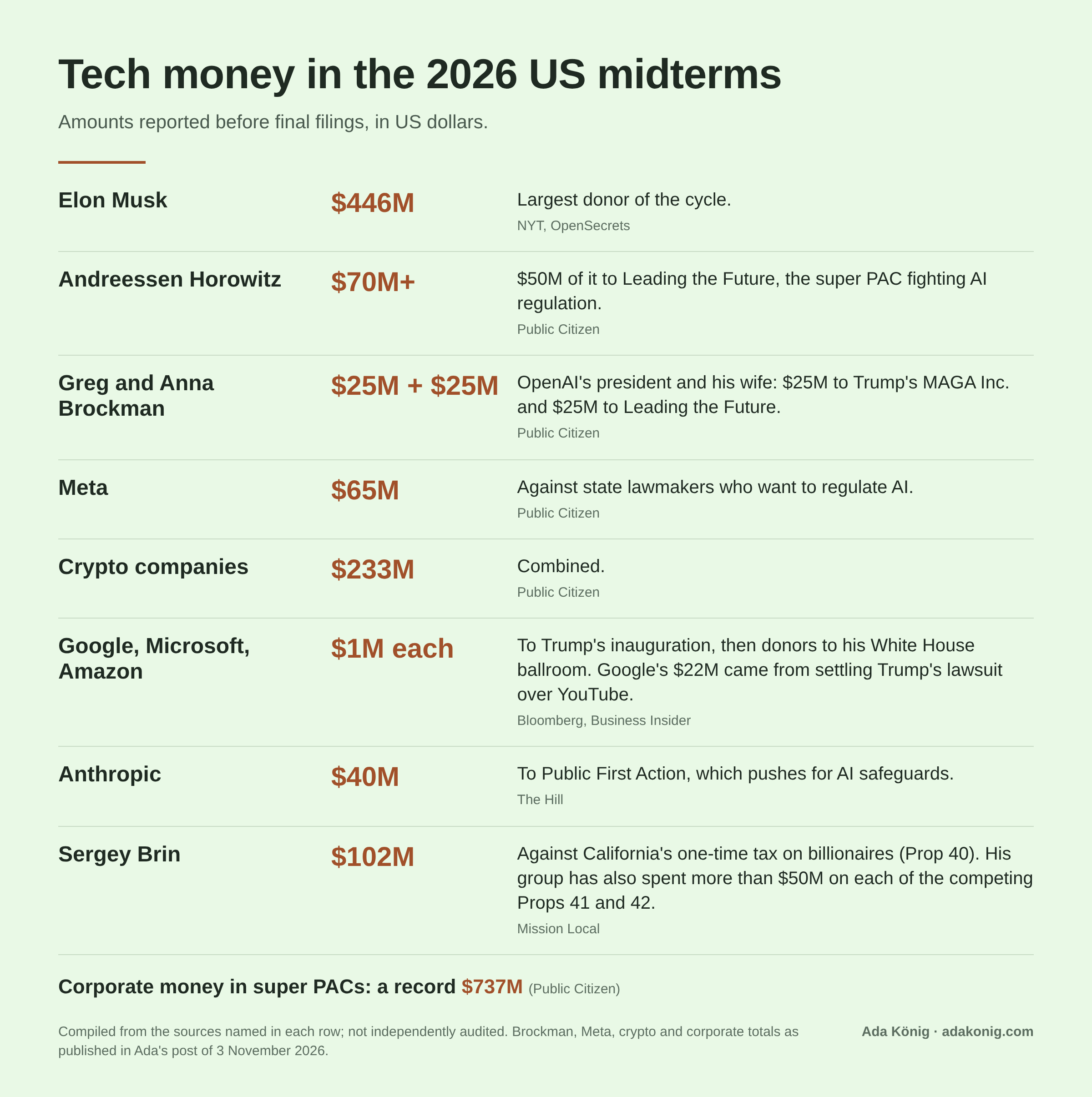
Elon Musk’s money and the AI industry’s money are two different things, and it helps to keep them apart. The first went mostly through the Senate Leadership Fund, the Republican Senate committee’s spending vehicle (a super PAC: it can raise unlimited sums but by law cannot coordinate with campaigns), and almost half of it is concentrated in a single race, the Texas Senate bid of the Republican Ken Paxton, according to a commentary based on reports filed with the Federal Election Commission, the agency that oversees election funding. The second has a different structure: Leading the Future, launched in August 2025 and funded among others by Greg and Anna Brockman (he is OpenAI’s president), has two affiliates, one for each party, and according to The Intercept it spent $7.4 million in the general election against about $34 million available, and $21.3 million in the Democratic primary against Alex Bores, a New York state assemblymember and author of a state AI law, who lost in June. I suspect the aim was to make it costly for a candidate to introduce AI bills, whichever party won. From the data I have read, I found no significant spending on governors’ races or local ballot measures, apart from $500,000 that Leading the Future gave on 9 October to an organisation that favours data centres. If that holds, the money was aimed at Congress and the primaries, and the decision that now threatens the investments matured where that money did not reach.
A governor’s power in this area depends on each state’s laws and in some cases will require agreement from legislators. In practice, a governor directs the agencies that issue permits. In September Abbott had already ordered the Texas environmental agency to pause permits for new data centres connecting to the grid, pending an audit; in July New York’s governor Kathy Hochul suspended data centres of 50 megawatts and above for a year, a decision Trump called terrible. So before the vote, two governors from different parties had already moved. I suspect the vote confirmed a shift that was already under way, and that the Republican candidates who distanced themselves from Trump on the issue saw it before the administration did, which in September was calling objections to data centres a “hoax”. According to an NBC exit poll, 56% of voters named AI and data centres as a crucial or major factor in their vote for Congress; I do not know how the question was worded, so I do not read it as proof that those voters chose for that reason.
At the federal level, if Democratic control of Congress is confirmed, Democrats will chair the committees in January. A committee decides which proposals reach a vote and can call hearings and demand documents; but a law needs the president’s signature, and overriding a veto takes two thirds of each chamber. I infer, as a hypothesis, that 2027 will bring more investigations than laws, and Politico reports that Musk will be a target for a party that wants to go after tech executives. The proposals exist: according to The New Republic, the FRONTIER Act by the Democratic representative Lori Trahan and the Republican Jay Obernolte would let the federal government suspend the use of risky models; the Democratic representative Ted Lieu’s AI Kill Switch Act we have already discussed; the Democratic representative Greg Casar and Senator Bernie Sanders want to ban what their text calls artificial superintelligence, an idea Trahan says has no chance of passing. On the question of whether a federal law should replace state AI laws, Broadband Breakfast reports that the Senate voted 99 to 1 in 2025 to remove a proposed ten-year moratorium on state laws, and expects a stalemate. I do not know whether a federal rule of this kind would also cover data centre permits, which are a matter of local and state planning; I suspect not, which would move the contest to where the industry has the fewest levers.
On public opinion the picture was already clear before the vote. A Reuters/Ipsos poll from October has 57% of voters convinced that the Trump administration is not taking AI risks seriously enough, and 56% in favour of limits on data centres, including 43% of Republicans. The FT points out that the objections concern air pollution, noise and electricity and water bills: costs people see in their own accounts. I doubt a list of donations changes many people’s view as much as a concrete case does. On 3 November the New York Times reported, and Common Dreams repeats, that from early next year schools that switch off Google’s AI will also lose Google Search, and Sanders called the policy extortion, setting it beside Trump’s late-September remark that tech executives “love our country”. If my hypothesis holds, a service people depend on that is made conditional on accepting AI weighs on the public as much as, or more than, the cost of a data centre.
On company strategy I can only offer hypotheses. The four big spenders (Amazon, Meta, Microsoft, Alphabet) are, according to the FT, on track to spend up to $740 billion on infrastructure in 2026, and Nvidia forecasts $3 to 4 trillion globally by 2030: with sums like these it is likely that they will look for sites in states without moratoriums; the Musk campuses the FT mentions are in Tennessee and Mississippi, and his late-night comment about data centres “in space” shows at least irritation with jurisdiction. I also expect an offer to municipalities (on 29 September Trump spoke of working with local communities), more intense work with the incoming committee chairs in Congress, and continued low-visibility spending: according to The Intercept, Leading the Future moved more than $30 million through two newly formed Delaware companies, and a complaint filed in May is stalled because the Federal Election Commission lacks the quorum to decide. A last hypothesis, more uncertain, concerns ballot measures: the Google co-founder Sergey Brin put $102 million against California’s tax on billionaires and backed competing measures on the same ballot, one of which could void it even if approved, as we noted. I have not found the result, and I do not know whether the same method will be used on data centres.
Then there is Trump, whom Politico describes as effectively forced into lame-duck status, with less power to push his agenda. He defended data centre construction against part of his own base; he keeps the veto and controls the executive branch, where decisions have been taken so far, as in the three phone calls. I suspect the companies will keep phoning him and start phoning governors and committee chairs too. In the coming weeks we can check what decisions the new governors take on permits and by which acts, whether the committees declare AI a priority, and whether Google explains why it does not offer Search without AI.